Forex for beginners starts with a funded demo account, one market structure skill and a fixed risk rule before any live trade
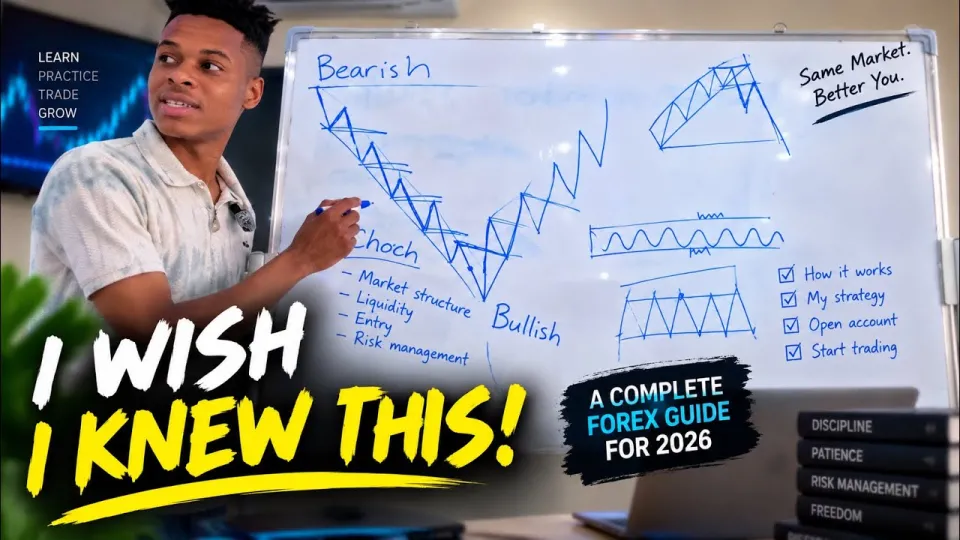
Video: How To Start Forex Trading For Beginners in 2026 (Full Guide + My Strategy)
Need articles like this for your video? They help promote it on YouTube and Google — order them in the Telegram bot @sat_sit_bot. It writes articles around your video, embeds the video and publishes them on popular niche websites (no ads). Your first 50 articles are free.
· based on the channel Carl Fx
Forex for beginners is the process of learning how currency pairs are quoted and traded, opening a broker account, practising on a demo, reading market structure and applying a fixed risk rule before risking real money. The market is open 24 hours a day from Monday to Friday, currencies trade in pairs, and retail traders reach it through a leveraged broker account such as the one offered via registration at TFC Global Markets. Nothing about that process requires a large deposit, but it does require order and patience.\n\nThe guide below follows the structure Carl Fx uses in his beginner walkthrough on the Carl Fx channel and expands it into something you can act on without watching the video first.\n\n## What forex trading actually is and how the market is priced\n\nForex is the exchange of one currency for another at an agreed price, and every retail trade is a bet on the direction of one currency against another. Prices are quoted in pairs: the first currency is the base, the second is the quote, so EUR/USD at 1.0850 means one euro buys 1.0850 US dollars.\n\n- Majors carry the tightest spreads and the deepest liquidity: EUR/USD, GBP/USD, USD/JPY, USD/CHF, AUD/USD, USD/CAD, NZD/USD.\n- Crosses exclude the US dollar, for example EUR/GBP or GBP/JPY, and usually cost more in spread.\n- Exotics such as USD/ZAR or USD/TRY offer wider ranges but thinner liquidity and higher spreads.\n\nThere is no central exchange. Banks, funds and brokers form an over-the-counter network, and your broker quotes you a price derived from that network. That is why spreads, commissions and execution quality differ from one broker to the next, and why the broker decision is part of the strategy rather than an afterthought.\n\nLeverage is the second mechanic to understand. A 1:100 account lets a $1,000 deposit control a $100,000 position, which magnifies both gains and losses. Leverage does not increase your edge; it only increases the size of the outcome, so position sizing has to come first.\n\n## Opening a trading account step by step\n\nOpening a trading account takes minutes online, but the choices made during signup shape your costs for as long as you trade.\n\n1. Pick the broker deliberately. Check regulation and the jurisdiction behind the licence, average spreads on EUR/USD, commission per lot, swap rates, minimum deposit, platform (MT4, MT5, cTrader or a proprietary app) and withdrawal terms.\n2. Register and verify. Expect an email address, phone number, proof of identity and proof of address; regulated brokers are required to run know-your-customer checks.\n3. Choose the account type. Standard accounts typically charge through the spread, while raw or ECN accounts pair tighter spreads with a commission per lot.\n4. Open the demo first. The same platform, the same charts, no money at risk.\n5. Fund small. When you move to live trading, start with an amount you can lose without changing your life.\n\nCarl Fx discloses in the video description that he owns TFC Global Markets and that his signup link promotes his own brokerage. That disclosure is exactly the kind of detail to look for from any educator who also sells access to a broker.\n\n\n\n## Reading bullish and bearish markets through market structure\n\nMarket structure is the sequence of swing highs and swing lows on a chart, and it tells you which side of the market is currently in control.\n\n- Bullish structure: price prints higher highs and higher lows. Buyers are stepping in earlier on each pullback.\n- Bearish structure: price prints lower highs and lower lows. Sellers are taking control on each bounce.\n- Range: highs and lows sit at roughly the same level, and trend tools produce false signals.\n\nA structure break happens when price fails to make a new high in an uptrend and instead takes out the most recent higher low. That break does not guarantee a reversal, but it changes the context and should change how aggressively you trade with the old trend.\n\nPrice action reading sits on top of structure: candlestick closes, wicks, rejection at a level, and consolidation before a move. Beginners often skip this and jump straight to indicators, which lag price by definition. Structure first, indicators second, and only if they add something.\n\n## A simple beginner strategy built around one setup\n\nA workable beginner strategy is one setup, one timeframe pair and one risk rule, repeated until the process becomes boring.\n\n1. Choose a pair and two timeframes. For example, EUR/USD on the four-hour chart for direction and the fifteen-minute chart for entries.\n2. Mark structure on the higher timeframe. Identify whether the market is bullish, bearish or ranging, and note the last swing high and swing low.\n3. Wait for a pullback into a level. A previous swing point, a round number or a session high often acts as a decision zone.\n4. Look for a confirmation candle. A close back in the direction of the higher-timeframe trend, not an entry in the middle of a candle.\n5. Place the stop beyond the structure. The stop loss goes past the swing that would invalidate the idea, not at an arbitrary number of pips.\n6. Size the position from the stop. If the stop is 20 pips away and you risk $10, the position is sized so that 20 pips equals $10.\n7. Set a target of at least twice the risk. A 1:2 reward-to-risk ratio means a strategy can be profitable while winning less than half of its trades.\n\nScreen time is the part beginners underestimate. A demo account run consistently for one to three months, with every trade logged and reviewed, teaches more than any additional course.\n\n## Risk rules that keep a small account alive\n\nRisk management is the only part of trading you fully control, and it decides whether you survive long enough to become consistent.\n\n- Cap risk at 1% of equity per trade; on a $1,000 account that is $10, and on a $100 account it is $1.\n- Cap total open risk across correlated pairs, because long EUR/USD and long GBP/USD is close to one trade, not two.\n- Expect drawdowns: a strategy winning 50% of trades at 1:2 still produces losing streaks of five or more trades regularly.\n- Avoid widening a stop loss to avoid a loss; that single habit erases accounts faster than bad analysis.\n- Keep a trade journal with entry, exit, reason and emotion, and review it weekly.\n\nTrading costs belong here too. A spread of 1 pip on a 0.10 lot position costs about $1 per round trip on EUR/USD, and frequent trading multiplies that figure quickly on a small balance.\n\n## Common beginner questions and mistakes\n\nMost beginner problems repeat across accounts, and the questions viewers raise under beginner guides follow the same pattern.\n\n- Struggling to open a live account. Verification documents, regional restrictions and payment methods are the usual blockers; contact broker support before depositing and confirm which methods work in your country.\n- Not understanding the material yet. That is normal at first. Reduce the scope to one pair, one setup and one timeframe, and revisit chart examples rather than collecting more strategies.\n- Wanting chart examples. Screenshots of structure breaks and pullback entries on a single pair are more useful than a dozen abstract diagrams; build a small library of your own marked-up charts.\n- Starting this week and expecting results. Starting is good; expecting profit within weeks is the mistake. Treat the first months as paid-for education with small size.\n- Overtrading after a win. A single good trade often triggers oversized follow-ups, which is where the gains disappear.\n- Ignoring the broker's ownership and incentives. If an educator profits from your signup, weigh the education on its merits and verify regulation independently.\n\nThe honest summary of beginner mistakes is short: too much size, too many pairs, too little logged evidence, and no written rule for when to stop for the day.\n\n## Useful links\n\n- Open a trading account with TFC Global Markets — the broker referenced in the video, owned by the creator.\n- Carl Fx free Telegram community — the channel's public community link.\n\n## Final takeaway\n\nForex rewards process over prediction, and the path from beginner to competent trader runs through a demo account, one understood setup, a written risk limit and a journal that shows the truth about your results. The Carl Fx walkthrough is a useful starting map because it covers the market, the account, structure and a simple strategy in one place, and its author is transparent about owning the brokerage he promotes. Treat every claim about returns with suspicion, including your own after a good week. Start small, stay regulated, and let consistency arrive before size does.
Key takeaways
- Forex is an over-the-counter market where currencies are quoted in pairs such as EUR/USD, and retail traders usually access it through a broker's leveraged account.
- A demo account should run for at least one to three months of consistent screen time before real money is deposited.
- Risk per trade is commonly capped at 1% of account equity, so a $1,000 account risks about $10 on a single position.
- Market structure — higher highs and higher lows versus lower highs and lower lows — is the base for reading bullish and bearish trends.
- Broker choice matters: regulation, spreads, execution and withdrawal terms should be checked before funding, and Carl Fx discloses ownership of TFC Global Markets.
Source: How To Start Forex Trading For Beginners in 2026 (Full Guide + My Strategy) · Markdown version
Questions & answers
How much money do I need to start forex trading?
There is no universal minimum, but many brokers accept deposits from $10 to $100, and some require $200 or more. What matters more is that the amount is disposable income: with a 1% risk rule, a $100 account risks $1 per trade, which limits how much you can learn from live results. Many traders run a demo until they have a repeatable process, then fund a small live account.
Is forex trading profitable for beginners?
Most beginners lose money in their first months, mainly through oversized positions and inconsistent rules rather than bad analysis. Profitability comes from a positive reward-to-risk ratio applied consistently over hundreds of trades, not from a few good calls. A realistic goal for the first year is a documented, rule-based process and controlled drawdown, not a target return.
Should I use a demo account or go straight to live trading?
Start on a demo to learn the platform, test the setup and build a journal without financial pressure. Move to live only when your demo results are consistent across at least a few dozen trades and your risk rule is automatic. A common middle step is a small live account where real emotions appear but the amounts stay trivial.
Which currency pair is best for a beginner?
Major pairs such as EUR/USD and GBP/USD are usually the most beginner-friendly because spreads are tight and liquidity is deep during the London and New York sessions. Pick one pair and study its behaviour across sessions instead of jumping between many instruments. Exotic pairs with wide spreads and gaps are best avoided until the process is stable.